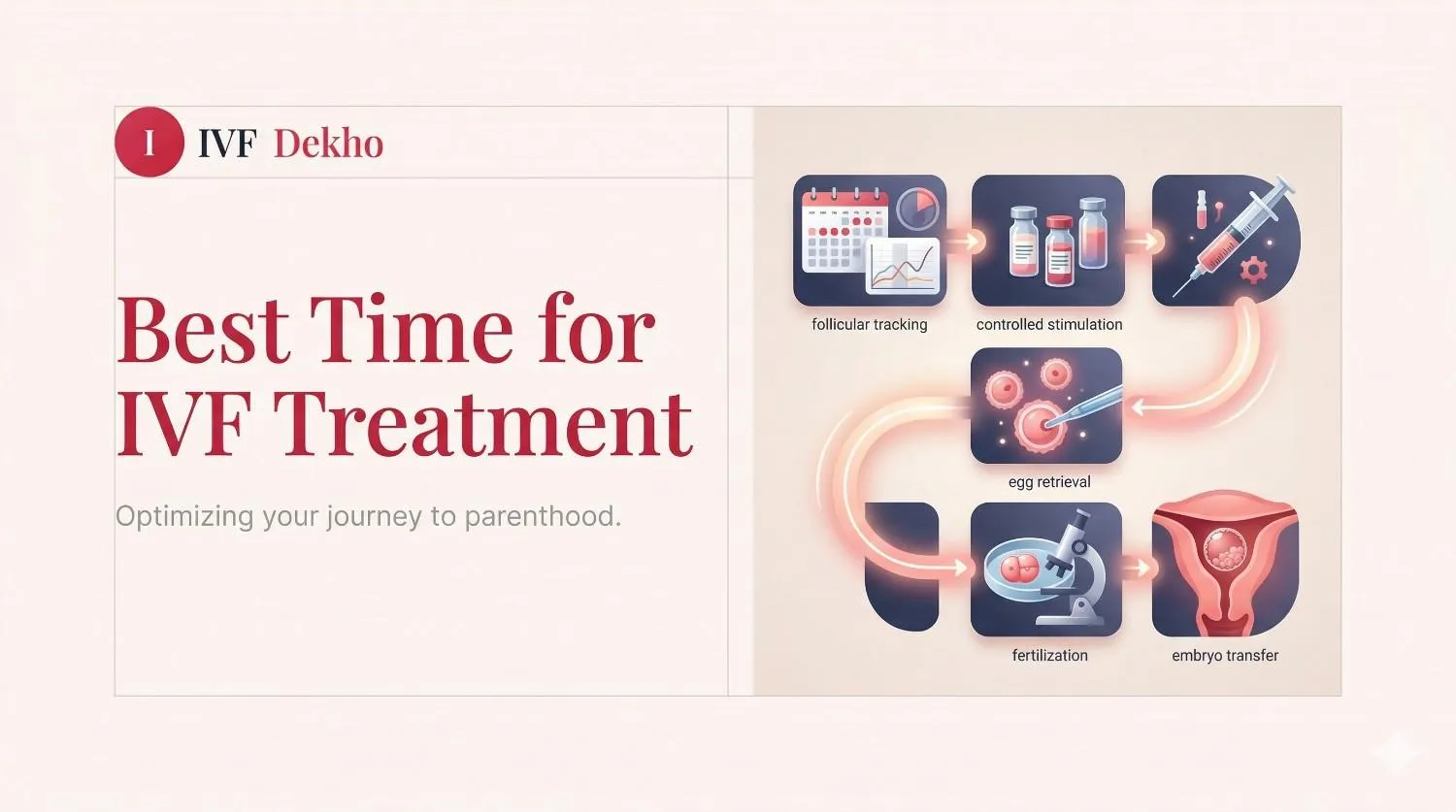
The best time for IVF treatment is a question that sits at the intersection of biology, personal circumstances, and clinical readiness, and it is one that far too many patients spend years trying to answer on their own. Some are waiting until finances feel right. Some are waiting for the relationship to feel stable enough. Some are simply waiting because no one has given them a clear, honest framework for making this decision.
This guide gives you exactly that. A clinically grounded, compassionately written answer to one of the most important questions in reproductive medicine.
Why Timing Matters More in IVF Than Almost Any Other Medical Decision
Most medical decisions can be revisited and adjusted with minimal consequence for delay. Fertility treatment is different in a fundamental way.
The biological clock is not a metaphor. It is a measurable, quantifiable reality that shows up in blood tests, ultrasound scans, and embryology reports. Ovarian reserve, the pool of eggs available for stimulation, declines continuously from birth and accelerates significantly after the mid-thirties.
The window for achieving the best outcomes with IVF is not infinite. And while IVF can be attempted at many ages, the clinical reality is that earlier treatment, when clinically indicated, almost always offers more options, better response, and higher cumulative success.
The Biological Reality: How Age Shapes IVF Outcomes
Understanding the best time for IVF treatment begins with understanding what age does to egg quality and quantity. These two factors, more than any others, determine the probability of a successful cycle.
Egg Quantity: The Ovarian Reserve Picture
Ovarian reserve is assessed through two primary markers:
- AMH (Anti-Mullerian Hormone): A blood test reflecting the remaining egg pool
- Antral Follicle Count (AFC): An ultrasound count of resting follicles in both ovaries
Both of these markers decline with age, but the decline is not linear. It accelerates sharply from around age 35 and more steeply again from 38 onward.
A woman at 32 with a normal AMH has a very different clinical starting point than a woman at 39 with a borderline AMH, even if both feel equally healthy and vital.
Egg Quality: The Chromosomal Dimension
Beyond quantity, the proportion of chromosomally normal eggs falls as age increases. This is the primary reason miscarriage rates rise and implantation rates fall in older patients.
- At age 35: approximately 40% to 50% of eggs carry abnormalities
- At age 40: approximately 60% to 70%
- At age 43: can exceed 80%
This is not a reflection of health or lifestyle. It is a feature of human reproductive biology that affects every woman uniformly.
IVF Success Rates by Age: The Data That Guides Timing
| Age Group | Live Birth Rate per Transfer (Own Eggs) | Recommended Action |
|---|---|---|
| Under 32 | 50% to 60% | Excellent prognosis; begin when clinically indicated |
| 32 to 35 | 42% to 52% | Good prognosis; avoid unnecessary delay if trying |
| 35 to 37 | 35% to 45% | Seek evaluation after 6 months of trying |
| 38 to 40 | 22% to 34% | Seek evaluation promptly; consider early IVF |
| 41 to 42 | 14% to 22% | Begin treatment without delay; discuss PGT-A |
| Over 43 | 4% to 10% | Discuss donor egg options alongside own-egg IVF |
These figures are approximate averages based on national registry data. Individual outcomes depend on specific ovarian reserve, diagnosis, and embryo quality.
What Is the Best Time for IVF Treatment by Age?
The most useful way to frame IVF timing is not as a single universal answer but as an age-contextualised decision that balances clinical probability with personal readiness.
In Your Late Twenties to Early Thirties
Women in this group have the highest ovarian reserve, the best egg quality, and the most favourable IVF success rates of any age group.
If you are in your late twenties or early thirties and facing a known fertility challenge such as blocked tubes, severe PCOS unresponsive to other treatments, or significant male factor infertility, this is genuinely the best time for IVF treatment from a biological standpoint.
Starting earlier does not mean rushing. It means responding to a diagnosis with appropriate clinical urgency rather than prolonged waiting.
In Your Mid to Late Thirties
This is the age range where timing becomes clinically urgent. Ovarian reserve decline accelerates, and chromosomal abnormalities increase.
If you are 35 to 38 and have been trying for six months without success, guidelines recommend seeking evaluation immediately rather than waiting longer.
Beginning IVF in your mid-thirties typically produces better outcomes than delaying into the early forties.
At 38 to 40
At this stage, the priority shifts from preparation to action. Women are advised to seek specialist evaluation promptly, ideally within three months.
Key clinical considerations include:
- Whether to proceed with own eggs or evaluate donor egg IVF
- Whether PGT-A testing is recommended
- Whether multiple cycles and embryo banking are needed
- Understanding realistic cumulative success rates
Over 40
For women over 40, the clinical recommendation is to begin IVF treatment as soon as possible.
Each month of delay significantly impacts egg availability and quality.
While pregnancy is still possible, outcomes improve when treatment begins promptly rather than after extended waiting.
Beyond Age: Other Factors That Determine the Right Time to Start IVF
Age is the most significant variable in IVF timing, but it is not the only one. Several other clinical and personal factors shape when IVF treatment is genuinely the right next step.
The Specific Diagnosis Driving Your Infertility
Certain diagnoses make IVF the most appropriate treatment from the outset, regardless of how long you have been trying. These include:
- Bilateral tubal blockage: Natural conception is anatomically impossible; IVF is the primary treatment
- Severe male factor infertility: Very low sperm count or zero sperm in ejaculate requires IVF with ICSI
- Severe endometriosis: Particularly when surgical intervention has not restored fertility
- Premature Ovarian Insufficiency (POI): Requires urgent specialist involvement and often donor egg IVF
- Failed IUI cycles: After two to three unsuccessful IUI cycles, IVF is the evidence-supported next step
In any of these situations, waiting to meet a time threshold before seeking IVF is not clinically appropriate. The diagnosis itself defines the ideal time to begin fertility treatment.
Your Emotional and Psychological Readiness
The best time for IVF treatment is also, in part, the time when you are psychologically equipped to navigate what it asks of you.
IVF involves daily injections, frequent clinic visits, and emotional highs and lows. This does not mean waiting until you feel no anxiety, as anxiety is completely normal.
It means ensuring you have a support structure in place, whether that is a partner, family, friends, or a fertility counsellor.
Patients with adequate psychological support tend to show better adherence, clearer decision-making, and greater resilience during treatment.
Lifestyle Optimisation Before Starting
There is a clinically meaningful preparation window of roughly two to three months before starting IVF that can improve outcomes.
Key preparation steps include:
- Achieving a healthy BMI: Both underweight and overweight conditions can reduce success rates
- Stopping smoking: Smoking negatively affects ovarian reserve and IVF outcomes
- Supplementation: Folic acid, CoQ10, and Vitamin D may support fertility
- Reducing alcohol consumption: Recommended before and during treatment
- Thyroid optimisation: Ensuring TSH is within the fertility-specific range
- Male partner preparation: Sperm quality can improve over a 70–90 day cycle with lifestyle changes
Always discuss supplementation and preparation plans with your fertility specialist before starting.
Financial and Practical Readiness
IVF is a significant financial commitment. Starting treatment without preparation for multiple cycles can add stress.
Ideally, plan for at least two to three cycles to ensure decisions are guided by clinical needs rather than financial constraints.
Multi-cycle packages, financing options, and insurance coverage should be reviewed before beginning treatment.
Seasonal Timing: Does the Time of Year Affect IVF Success?
Patients frequently ask whether there is a better season to start IVF, and the honest clinical answer is that robust peer-reviewed evidence for a strong seasonal effect on outcomes remains limited.
Some smaller studies have suggested modest improvements in fertilisation rates during spring and early autumn cycles, potentially linked to natural light exposure and Vitamin D levels. However, these findings have not been consistently replicated at scale.
What is far more clinically significant than the season is the individual patient's ovarian reserve at the time of treatment, the quality of the stimulation protocol, and the expertise of the treating team.
Waiting for a specific month to begin treatment is not supported by the evidence.
The right season for IVF is the season in which your clinical and personal preparation is complete and your specialist recommends proceeding.
When Earlier Is Not Always the Answer: Planned Delays That Make Clinical Sense
There are specific situations where a short, structured delay before beginning IVF is genuinely the right clinical decision. These include:
- Active uterine pathology: Polyps, submucous fibroids, or a thin uterine lining should be treated before embryo transfer
- Uncontrolled thyroid disease: Thyroid function must be optimised before stimulation begins
- Active infection: Any reproductive tract infection must be treated and cleared first
- Significant weight-related risk: A structured weight management programme can improve outcomes
- Severe sperm DNA fragmentation: A 3-month intervention period may improve embryo quality
In each of these situations, a delay is not procrastination. It is evidence-based preparation that increases the probability of a successful first cycle.
A Message for Every Patient Still Waiting
If you have been putting off the conversation about IVF because you are waiting for the right time, it is worth gently considering whether the wait is serving your interests or your anxiety.
Fear of the process, fear of a difficult result, fear of what starting treatment means about where you are in your journey. These are all entirely human responses. But they are not clinical reasons to delay.
The best time for IVF treatment is almost always determined by your biology and your diagnosis, not by how ready the idea feels. And your biology, unfortunately, does not pause while you are deciding.
The most courageous and, as the data consistently shows, the most clinically effective decision is to seek specialist input early, understand your specific picture clearly, and build a treatment timeline that reflects your actual reproductive health rather than a generalised sense of when things should feel right.