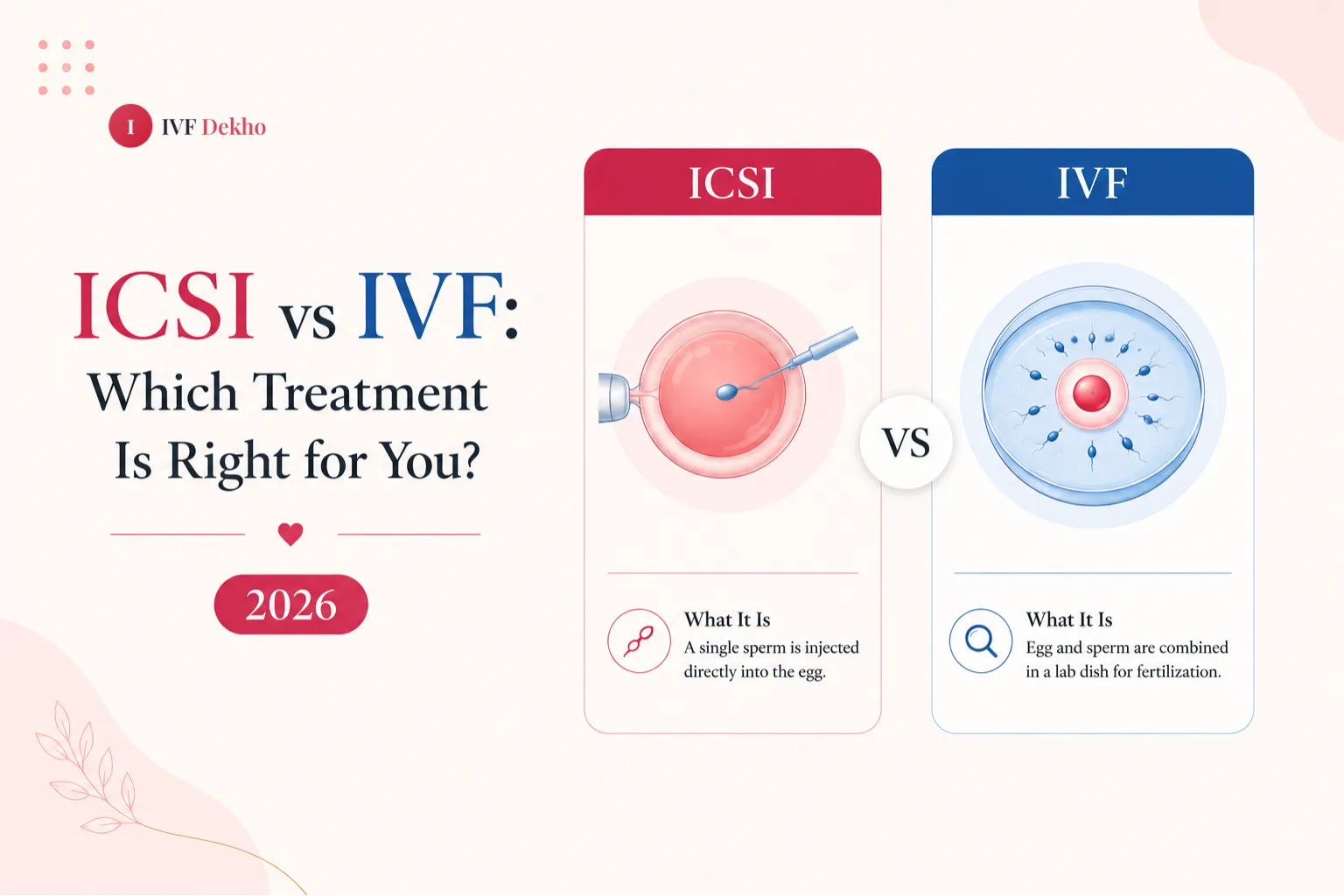
The ICSI vs IVF decision affects fertilisation success, total cost, and how quickly a couple reaches pregnancy. Many patients walk into a fertility clinic assuming IVF is the default, only to learn that ICSI may be the better-suited technique for their specific diagnosis.
Both procedures fall under assisted reproductive technology, but they handle the most critical moment, the meeting of sperm and egg, in completely different ways.
This guide breaks down the medical, financial, and practical aspects of both treatments so you can have an informed conversation with your fertility specialist.
What Is Conventional IVF? A Quick Refresher
In Vitro Fertilisation (IVF) is the standard assisted reproductive procedure. Eggs are retrieved from the ovaries and placed in a laboratory dish along with thousands of motile sperm.
Fertilisation happens naturally. The sperm swim toward the egg and the strongest one penetrates it on its own.
The resulting embryos are cultured for three to five days and then transferred into the uterus. IVF is the right choice when sperm parameters are normal or near-normal.
Key Features of IVF
- Sperm and egg meet without direct intervention
- Requires healthy sperm count, motility, and morphology
- Less expensive than ICSI
- Suitable for tubal factor and unexplained infertility
- Standard option when male factor is not a concern
What Is ICSI? Understanding the Procedure
Intracytoplasmic Sperm Injection (ICSI) is a specialised laboratory technique. A single healthy sperm is selected by the embryologist and injected directly into a mature egg using a microscopic glass needle.
The process bypasses the natural sperm selection process entirely. This makes it the gold-standard solution when sperm cannot fertilise the egg on their own.
ICSI was introduced in the early 1990s and has revolutionised outcomes for couples facing severe male factor infertility.
Key Features of ICSI
- One sperm injected directly into each mature egg
- Requires advanced embryology lab and skilled embryologist
- More expensive due to specialised micromanipulation
- Higher fertilisation rate when male factor is present
- Useful even when sperm count is extremely low
Difference Between ICSI and IVF at a Glance
The core difference between ICSI and IVF lies in how fertilisation is achieved. In conventional IVF, fertilisation is left to chance inside the dish. In ICSI, the embryologist controls the moment of fertilisation directly.
This single technical difference drives variations in cost, indication, and outcomes.
Quick Comparison Table
| Factor | Conventional IVF | ICSI |
|---|---|---|
| Fertilisation method | Sperm swims to egg naturally | Sperm injected directly |
| Sperm count required | Normal to mildly low | Even very low works |
| Skill demand on lab | Standard | Highly specialised |
| Cost per cycle (India) | ₹1,00,000 to ₹2,00,000 | ₹1,50,000 to ₹2,50,000+ |
| Fertilisation rate | 50 to 70 percent | 70 to 85 percent |
| Live birth rate | Comparable when fertilisation occurs | Comparable when fertilisation occurs |
| Best for | Tubal factor, unexplained, female-only issues | Male factor, prior fertilisation failure |
| Embryo freezing | Available | Available |
| PGT compatibility | Yes | Yes (often combined) |
ICSI Procedure: Step-by-Step Process
The ICSI procedure follows the same overall cycle as IVF, with one critical laboratory difference. The fertilisation step is performed manually by the embryologist instead of allowing natural fertilisation in the dish.
Understanding the steps helps couples prepare for what is medically a more delicate process.
Standard ICSI Cycle Steps
- Pre-treatment workup: AMH, AFC, semen analysis with DFI, uterine assessment
- Ovarian stimulation: 8 to 14 days of injectable gonadotropins
- Monitoring scans: Follicle tracking every 2 to 3 days
- Trigger injection: Final egg maturation
- Egg retrieval: Under sedation, 20 to 30 minutes
- Sperm preparation: Sample washed, best sperm selected
- ICSI injection: One sperm injected into each mature egg under microscope
- Embryo culture: Development monitored for 3 to 5 days
- Embryo transfer: Best embryo placed into the uterus
- Luteal support: Progesterone medications
- Beta hCG test: 10 to 14 days after transfer
The added step that distinguishes ICSI vs IVF is the micromanipulation phase, which takes place under high-powered microscope by an experienced embryologist.
ICSI vs IVF Cost in India: Full Breakdown
Cost differences between ICSI and IVF in India typically range from 20 to 30 percent. ICSI adds embryologist time, specialised equipment, and additional laboratory consumables to the base IVF cycle.
The price gap is meaningful but rarely the deciding factor. Most couples who need ICSI are not paying extra for choice. They are paying for the only technique that will produce a viable embryo.
IVF Cost in India (Per Cycle)
| Cost Component | Range (INR) |
|---|---|
| Diagnostics and consultation | 10,000 to 18,000 |
| Stimulation medications | 60,000 to 1,20,000 |
| Egg retrieval | 25,000 to 40,000 |
| Embryology lab (conventional) | 30,000 to 50,000 |
| Embryo transfer | 15,000 to 25,000 |
| Typical IVF total | ₹1,00,000 to ₹2,00,000 |
ICSI Cost in India (Per Cycle)
| Cost Component | Range (INR) |
|---|---|
| Diagnostics and consultation | 10,000 to 18,000 |
| Stimulation medications | 60,000 to 1,20,000 |
| Egg retrieval | 25,000 to 40,000 |
| Embryology lab + ICSI procedure | 55,000 to 90,000 |
| Embryo transfer | 15,000 to 25,000 |
| Typical ICSI total | ₹1,50,000 to ₹2,50,000+ |
The additional cost of ICSI is justified when male factor is present. Skipping ICSI in such cases often leads to fertilisation failure and a wasted full IVF cycle, which costs far more in real terms.
ICSI Success Rate vs IVF Success Rate: What the Data Shows
When couples compare the ICSI vs IVF success picture, the headline number can mislead. Fertilisation rate and live birth rate are two different metrics.
ICSI delivers higher fertilisation rates when male factor is present. However, once an embryo forms, the live birth rate is broadly similar between the two techniques.
Fertilisation Rate Comparison
| Scenario | Conventional IVF | ICSI |
|---|---|---|
| Normal sperm parameters | 60 to 70 percent | 70 to 80 percent |
| Mild male factor | 30 to 50 percent | 70 to 80 percent |
| Severe male factor | 10 to 25 percent | 65 to 80 percent |
| Surgical sperm (TESA/PESA) | Not applicable | 50 to 70 percent |
Live Birth Rate Per Cycle (Under 35, Per Embryo Transfer)
| Treatment | Live Birth Rate |
|---|---|
| Conventional IVF | 40 to 50 percent |
| ICSI (when indicated) | 40 to 50 percent |
| ICSI for severe male factor | 35 to 45 percent |
The key takeaway is that ICSI does not magically improve pregnancy chances when conventional IVF would have worked equally well. Its real value lies in cases where IVF alone would fail.
When Is ICSI Recommended Over IVF?
ICSI is not a premium upgrade. It is a medically indicated technique with specific clinical use cases.
A responsible fertility clinic will recommend ICSI only when the diagnosis genuinely calls for it.
Clear Indications for ICSI
- Sperm count below 15 million per millilitre
- Sperm motility below 32 percent
- Abnormal sperm morphology (below 4 percent normal forms)
- High sperm DNA fragmentation index (DFI)
- Surgically retrieved sperm (TESA, PESA, micro-TESE)
- Prior IVF cycle with poor fertilisation rate
- Frozen sperm with limited count
- Previous unexplained fertilisation failure
- Use of frozen-thawed eggs
- Pre-implantation genetic testing (PGT-A or PGT-M) planned
- Older eggs where zona pellucida may be hardened
If your diagnosis matches any of these conditions, the ICSI vs IVF decision typically favours ICSI as the safer technical choice.
When Does Conventional IVF Make More Sense?
For couples without male factor concerns, conventional IVF often delivers equally good outcomes at lower cost. Adding ICSI without indication does not improve success rates.
In fact, several international fertility society guidelines now caution against overuse of ICSI in cases where standard IVF would suffice.
IVF Without ICSI Works Well When
- Sperm count, motility, and morphology are normal
- Tubal factor infertility is the primary diagnosis
- Female-only diagnoses such as endometriosis or PCOS
- Previous IVF cycle showed good fertilisation
- Donor sperm of confirmed normal quality is used
- Budget is a meaningful constraint
In these scenarios, conventional IVF protects the couple from unnecessary expense and additional laboratory manipulation.
ICSI for Male Infertility: Why It Changes Outcomes
ICSI was developed specifically to solve male factor infertility. Before its introduction, men with severe sperm issues had limited options outside donor sperm.
Today, even men with extremely low sperm counts or those whose sperm must be surgically retrieved can become biological fathers through ICSI.
Male Infertility Conditions Where ICSI Works
| Condition | How ICSI Helps |
|---|---|
| Oligospermia (low count) | Only one sperm needed per egg |
| Asthenospermia (low motility) | Sperm selected manually, motility less critical |
| Teratospermia (poor morphology) | Best-looking sperm chosen under microscope |
| Azoospermia (no sperm in semen) | Sperm retrieved via TESA or PESA can be used |
| High DNA fragmentation | Best sperm visually selected |
| Anti-sperm antibodies | Direct injection bypasses immune barriers |
| Failed previous IVF fertilisation | ICSI rescues cycles where IVF failed |
For couples facing these diagnoses, the ICSI vs IVF comparison is rarely a real debate. ICSI is medically the right choice.
Risks and Limitations: Honest Comparison
Both procedures are considered safe when performed at accredited fertility centres. However, each has specific risks worth understanding.
Risks of Conventional IVF
- Fertilisation failure (especially with undiagnosed male factor)
- Ovarian Hyperstimulation Syndrome (OHSS) risk
- Multiple pregnancy if more than one embryo transferred
- Emotional toll of failed cycles
Risks Specific to ICSI
- Slightly higher chance of egg damage during injection (under 5 percent)
- Marginally higher reported risk of certain congenital conditions in some studies
- Higher cost without benefit when not medically indicated
- Skips natural sperm selection, which some researchers debate
Most published research suggests that babies born via ICSI are as healthy as those born via conventional IVF. The medical community continues to monitor long-term outcomes through ongoing registries.
Making the Right Choice with Your Doctor
The final ICSI vs IVF decision must be made by a qualified fertility specialist after reviewing your complete diagnostic profile. Avoid clinics that recommend ICSI by default without strong medical justification.
A trustworthy specialist will base the choice on three factors. Semen analysis results, previous cycle history if any, and overall treatment plan including genetic testing needs.
Decision Framework
| Patient Profile | Suggested Treatment |
|---|---|
| Normal semen parameters, tubal factor | Conventional IVF |
| Normal semen, unexplained infertility | Conventional IVF first |
| Mild male factor | ICSI recommended |
| Severe male factor | ICSI strongly indicated |
| Azoospermia with surgical retrieval | ICSI is the only option |
| Previous fertilisation failure | ICSI for next cycle |
| PGT-A or PGT-M planned | ICSI typically used |
| Frozen-thawed eggs | ICSI recommended |
| Older woman with normal sperm | Conventional IVF acceptable |
Use this matrix as a starting point. Validate with your treating doctor based on your specific reports before committing to a treatment plan.
Get Expert Guidance Today
The right ICSI vs IVF choice can shorten your fertility journey, reduce wasted cycles, and improve your chance of bringing home a healthy baby. The wrong choice can cost time, money, and emotional energy.
IVF Dekho helps couples across India compare verified fertility clinics, review success rates, and connect with experienced specialists. Browse our directory to find a centre that offers both conventional IVF and ICSI with transparent pricing and proven outcomes.