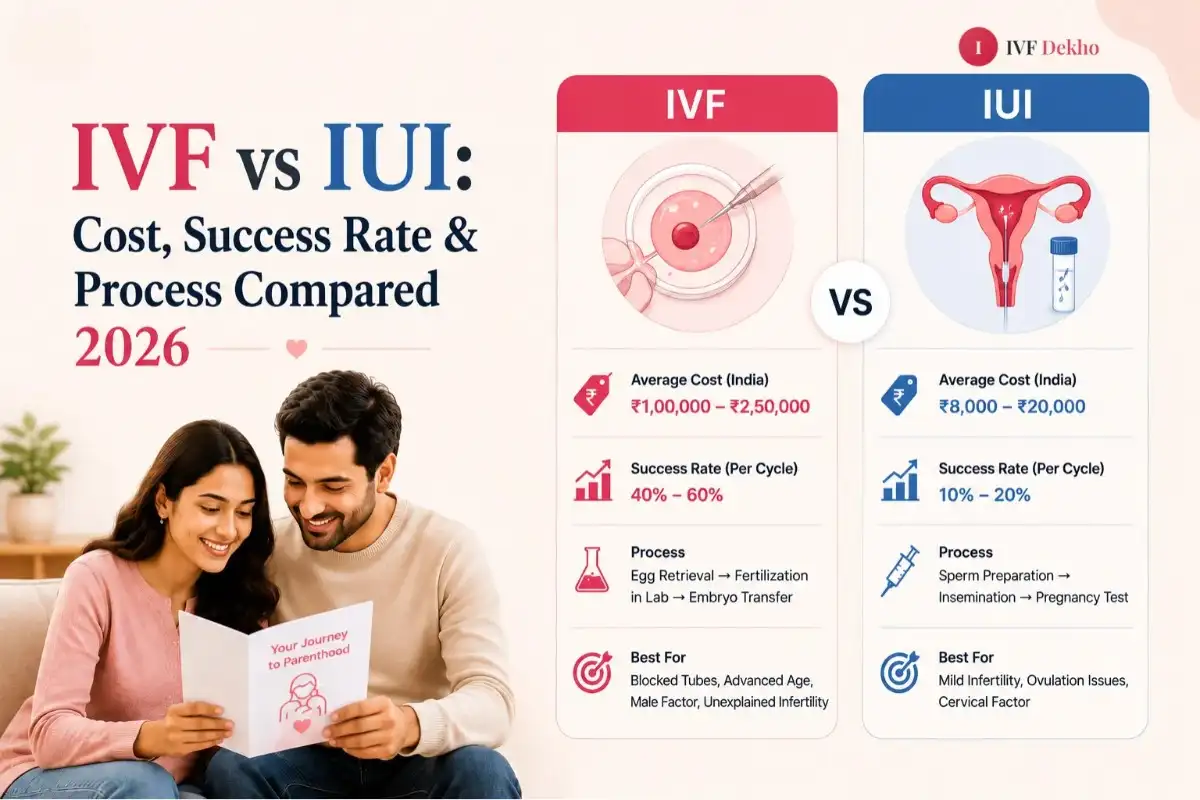
The IVF vs IUI decision is one of the first crossroads every couple faces when fertility challenges enter the conversation. Both procedures are legitimate assisted reproductive technologies in India, but they serve very different medical purposes.
Choosing wrong does not just cost money. It costs time, and in fertility, time directly affects success rates. This guide breaks down every angle that should influence your decision.
The information here reflects current Indian clinic data, success rate ranges reported by Indian fertility specialists, and the most recent pricing benchmarks for 2026.
What Is IUI? A Quick Overview
Intrauterine Insemination (IUI) is one of the simplest fertility treatments available. Washed and concentrated sperm is placed directly inside the uterus around the time of ovulation.
The aim is to shorten the distance sperm needs to travel and increase the number of healthy sperm reaching the egg. Fertilisation still happens naturally inside the woman's body.
IUI is typically the first-line treatment for couples with mild infertility, especially when the woman is under 35 and at least one fallopian tube is open.
Key Features of IUI
- Minimally invasive procedure
- Completed in 15 to 20 minutes
- No anaesthesia required
- Performed in an outpatient setting
- Often supported with ovulation-stimulating medication
What Is IVF? A Quick Overview
In Vitro Fertilisation (IVF) is a more advanced procedure where eggs are retrieved from the ovaries and combined with sperm in a controlled laboratory environment. The resulting embryo is then transferred back into the uterus.
IVF bypasses the fallopian tubes entirely. This makes it the only viable option for women with blocked or damaged tubes, severe male factor infertility, or repeated IUI failures.
The treatment is significantly more complex, more medically intensive, and more expensive than IUI, but the per-cycle success rates are notably higher.
Key Features of IVF
- Multi-step laboratory-based procedure
- Spans four to six weeks per cycle
- Involves daily hormone injections
- Egg retrieval performed under sedation
- Embryos can be frozen for future cycles
Difference Between IVF and IUI at a Glance
The fundamental difference between IVF and IUI lies in where fertilisation happens. In IUI, fertilisation occurs naturally inside the uterus. In IVF, fertilisation occurs in a laboratory dish.
This single distinction drives every other difference, from cost and process to success rates and recovery time.
Quick Comparison Table
| Factor | IUI | IVF |
|---|---|---|
| Fertilisation location | Inside the body | Outside the body (lab) |
| Cycle duration | 2 to 3 weeks | 4 to 6 weeks |
| Anaesthesia | Not needed | Mild sedation for retrieval |
| Cost per cycle (India) | ₹8,000 to ₹25,000 | ₹1,20,000 to ₹2,50,000 |
| Success rate (under 35) | 10 to 20 percent | 35 to 50 percent |
| Suitability for blocked tubes | Not suitable | Highly suitable |
| Severe male factor | Not effective | Effective with ICSI |
| Embryo freezing option | Not applicable | Available |
| Genetic testing (PGT) | Not possible | Available |
IUI vs IVF Process: Step-by-Step Comparison
Understanding the IUI vs IVF process side by side helps couples mentally prepare for the journey ahead. Both involve hormonal monitoring, but the depth and intensity differ significantly.
IUI Process Steps
- Cycle monitoring: Ultrasound and hormone tracking to identify ovulation
- Optional ovulation induction: Mild medication like letrozole or clomiphene
- Trigger shot: Given to time ovulation precisely
- Sperm preparation: Semen sample washed in the lab to isolate motile sperm
- Insemination: Prepared sperm inserted through a thin catheter into the uterus
- Two-week wait: Pregnancy test confirms the outcome
IVF Process Steps
- Pre-treatment workup: AMH, AFC, semen analysis, uterine assessment
- Ovarian stimulation: 8 to 14 days of injectable gonadotropins
- Monitoring: Every 2 to 3 days to track follicle growth
- Trigger injection: Final maturation of eggs
- Fertilisation: IVF or ICSI performed in the embryology lab
- Embryo culture: 3 to 5 days of development under controlled conditions
- Embryo transfer: One or two embryos placed into the uterus
- Luteal phase support: Progesterone medications
- Beta hCG test: 10 to 14 days after transfer
Cost Comparison: IUI Cost in India vs IVF Cost in India
Cost is one of the biggest deciding factors in the IVF vs IUI conversation. IUI is dramatically more affordable, but couples often underestimate the cumulative cost of multiple IUI attempts.
If three to four IUI cycles fail, the cumulative spend can approach the cost of one IVF cycle without delivering a baby.
IUI Cost in India (Per Cycle)
| Cost Component | Range (INR) |
|---|---|
| Baseline consultation | 500 to 1,500 |
| Ovulation monitoring | 2,000 to 4,000 |
| Medications (oral) | 1,500 to 4,000 |
| Injectables (if used) | 5,000 to 10,000 |
| Sperm wash and insemination | 4,000 to 8,000 |
| Total typical range | ₹8,000 to ₹25,000 |
IVF Cost in India (Per Cycle)
| Cost Component | Range (INR) |
|---|---|
| Diagnostics and consultation | 10,000 to 18,000 |
| Stimulation medications | 60,000 to 1,20,000 |
| Egg retrieval | 25,000 to 40,000 |
| Embryology lab fees | 30,000 to 50,000 |
| Embryo transfer | 15,000 to 25,000 |
| ICSI add-on (if needed) | 25,000 to 40,000 |
| Total typical range | ₹1,20,000 to ₹2,50,000 |
Success Rate Comparison: What the Numbers Reveal
When couples ask which is better in the IVF vs IUI choice, success rate data tells a clear story. IVF consistently delivers higher per-cycle outcomes across all age groups.
However, IUI cumulative success after 3 to 4 cycles can be reasonable for younger couples with mild infertility.
Per-Cycle Success Rate by Age
| Female Age | IUI Success Rate | IVF Success Rate |
|---|---|---|
| Under 30 | 15 to 20 percent | 45 to 55 percent |
| 30 to 34 | 12 to 18 percent | 40 to 50 percent |
| 35 to 37 | 10 to 14 percent | 30 to 40 percent |
| 38 to 40 | 5 to 10 percent | 20 to 28 percent |
| Above 40 | Less than 5 percent | 5 to 12 percent |
The pattern is consistent. Per cycle, IVF roughly triples the chance of pregnancy compared to IUI. The gap widens further with increasing age.
Cumulative Success Picture
Three to four IUI cycles can deliver a cumulative pregnancy rate of around 30 to 40 percent in women under 35. One IVF cycle alone matches that range and finishes faster.
When to Choose IUI First
IUI remains a reasonable first step for specific patient profiles. The right candidate can save significant cost and avoid more intensive treatment.
IUI Is a Good First Choice When
- The woman is under 35
- At least one fallopian tube is open and functional
- Sperm count and motility are within mild deficit range
- The infertility duration is under two years
- Ovarian reserve (AMH) is normal
- The couple wants to start with a less invasive option
Many specialists suggest a maximum of 3 to 4 IUI cycles before reassessing. Beyond this, the diminishing returns rarely justify continued attempts.
When to Choose IVF Directly
In several clinical situations, skipping IUI entirely and moving directly to IVF is the medically sound decision.
IVF Is the Better Direct Choice When
- The woman is above 38
- Both fallopian tubes are blocked or damaged
- Severe male factor infertility is diagnosed
- AMH is low or ovarian reserve is poor
- Endometriosis is moderate to severe
- Three or more IUI cycles have already failed
- Genetic screening (PGT-A or PGT-M) is needed
- Time is a critical factor due to age
Going straight to IVF in these cases preserves precious months that would otherwise be spent on low-yield IUI attempts.
Side Effects and Risks: Honest Comparison
Every fertility treatment carries some risk. Understanding these helps couples weigh the IVF vs IUI choice realistically.
IUI Risks
- Mild cramping after the procedure
- Risk of multiple pregnancy if injectables are used
- Rare risk of pelvic infection
- Emotional toll of repeated failed cycles
IVF Risks
- Ovarian Hyperstimulation Syndrome (OHSS) in 1 to 5 percent of cases
- Discomfort from daily hormone injections
- Risk of multiple pregnancy if two embryos are transferred
- Slightly higher risk of preterm or low birth weight birth
- Greater emotional and financial intensity
Both treatments are considered safe when performed at accredited fertility centres with experienced specialists.
Emotional and Physical Journey
The IVF vs IUI experience is not just medical. It is deeply emotional and physically demanding in different ways.
IUI is gentler on the body but can feel emotionally heavier when repeated cycles fail. Each failed attempt prompts the question of whether to try again or escalate.
IVF compresses the medical intensity into a shorter window but demands more from the body, the schedule, and the budget. The reward is faster clarity and higher per-cycle outcomes.
Emotional Considerations Side by Side
| Aspect | IUI | IVF |
|---|---|---|
| Physical intensity | Low | Moderate to high |
| Daily injection burden | Minimal | High |
| Clinic visits per cycle | 3 to 5 | 8 to 12 |
| Emotional intensity per cycle | Low to moderate | High |
| Recovery time | Same day | 2 to 3 days |
| Time to clarity | Slow (multi-cycle) | Faster |
Final Decision Framework
After weighing all factors in the IVF vs IUI comparison, the right answer depends on three variables. Age, diagnosis, and time available.
Use this simple framework as a starting point. Then confirm the decision with a qualified fertility specialist after a complete workup.
Decision Matrix
| Patient Profile | Suggested First Step |
|---|---|
| Under 35, open tubes, mild diagnosis | Start with IUI (3 to 4 cycles) |
| Under 35, unexplained, normal reports | Start with IUI, switch to IVF if needed |
| 35 to 37, normal reports | Consider IUI briefly or move to IVF |
| Above 38 | Go directly to IVF |
| Blocked tubes, severe male factor | Go directly to IVF |
| Low AMH or diminished reserve | Go directly to IVF |
| Genetic concerns | IVF with PGT testing |
Choosing the right path from the start is more important than chasing the cheapest first option. A thoughtful IVF vs IUI decision protects time, emotional energy, and your overall chance of bringing home a baby.