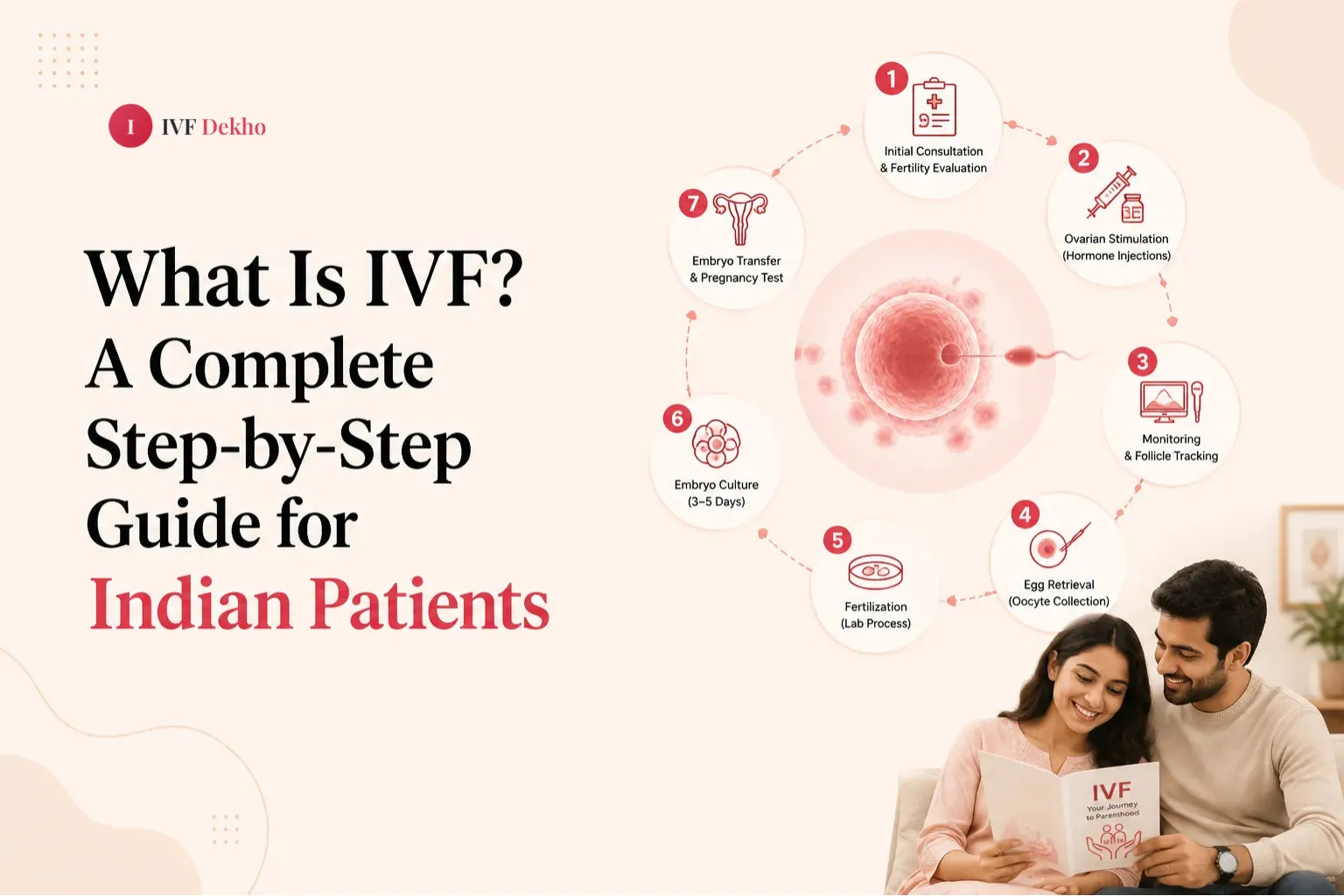
Understanding the IVF process step by step has become one of the most important first actions a couple can take when natural conception is delayed, and in 2026, this knowledge is more critical than ever for Indian patients navigating modern fertility care. India now reports a national infertility rate of nearly 13%, with roughly 27.5 million couples affected, and IVF treatment in India has shifted from a niche option into mainstream reproductive healthcare.
This guide walks you through every clinical stage, the latest 2026 technologies, realistic success rates, current cost ranges, the legal framework, and how to identify the best IVF centre in Bangalore for your specific case. Each section is written for first-time patients with no prior medical background, so concepts are kept simple and decision-ready.
1. What Is IVF? Understanding In Vitro Fertilization in Simple Terms
In Vitro Fertilization, commonly known as IVF, is an assisted reproductive technology where eggs are retrieved from the ovaries and fertilized with sperm in a specialized laboratory rather than inside the body. The fertilized egg, now called an embryo, is grown in a controlled incubator for several days and then transferred into the uterus to allow implantation and pregnancy.
When patients ask what IVF treatment is in plain language, the simplest answer is this: IVF is the process of helping conception happen outside the body when it cannot happen inside it. The technique was first successful in 1978, and since then, more than 8 million babies have been born globally through IVF.
How IVF Works: The Core Concept
For a natural pregnancy, sperm must travel up through the uterus, meet a healthy egg in the fallopian tube, fertilize it, and the resulting embryo must implant in the uterus. IVF bypasses several of these natural steps by handling fertilization in the embryology lab and transferring a developed embryo directly into the uterus.
Why IVF Has Moved Mainstream in India in 2026
Three forces are driving rapid adoption: rising infertility linked to delayed parenthood and lifestyle changes, advanced lab technology now available in tier one Indian cities, and far stronger regulatory oversight under the ART Act 2021. Bangalore has emerged as a leading IVF hub due to its concentration of high end laboratories and experienced specialists.
2. Who Needs IVF? Common Causes of Infertility in Indian Couples
A couple is generally evaluated for IVF if pregnancy has not occurred after 12 months of unprotected intercourse, or after 6 months if the female partner is over 35. The IVF process step by step is most commonly recommended for couples with one or more identifiable fertility issues.
Female Factor Infertility
Common female causes include:
- Polycystic Ovary Syndrome (PCOS) affects ovulation
- Blocked or damaged fallopian tubes
- Endometriosis disrupts egg or implantation quality
- Diminished ovarian reserve, especially after age 35
- Uterine issues such as fibroids or adhesions
- Unexplained infertility after a complete workup
Male Factor Infertility
Male factor accounts for nearly 40% of cases in India and includes:
- Low sperm count (oligospermia)
- Poor sperm motility (asthenospermia)
- Abnormal sperm shape (teratospermia)
- Azoospermia (absence of sperm), often treated with TESA or PESA combined with ICSI
- High sperm DNA fragmentation
When You Should Consult a Fertility Specialist
You should book an evaluation if you are under 35 and have tried for a year, over 35 and have tried for six months, have irregular periods, have experienced two or more miscarriages, or already have a known reproductive condition. Early consultation with a fertility specialist in Bangalore preserves more treatment options and protects ovarian reserve.
3. Pre-IVF Preparation: Tests and Diagnostic Workup
Before starting any treatment cycle, both partners go through a structured diagnostic phase. This usually takes 2 to 4 weeks and helps the team design a personalised protocol.
Initial Fertility Consultation Checklist
The first visit typically includes a full medical and reproductive history, a transvaginal ultrasound, a baseline hormone panel, and a discussion of likely treatment options. Patients should bring previous medical records, any prior fertility test results, and a list of current medications.
Essential Tests for Women
| Test | What It Measures |
|---|---|
| AMH (Anti-Mullerian Hormone) | Ovarian reserve |
| FSH and Estradiol | Hormonal baseline on day 2 or 3 |
| Transvaginal Ultrasound | Antral follicle count, uterine health |
| HSG or Sono-HSG | Fallopian tube patency |
| Thyroid (TSH) and Prolactin | Endocrine balance |
| Infectious Disease Screen | HIV, Hepatitis B and C, VDRL |
Essential Tests for Men
A standard semen analysis evaluates volume, count, motility, and morphology. Many clinics in 2026 also recommend a Sperm DNA Fragmentation Index (DFI) test for men with previous IVF failures or unexplained infertility.
Lifestyle Modifications Before Starting Treatment
Patients are usually advised to begin folic acid supplementation, stop smoking and alcohol, reduce caffeine, maintain a healthy BMI, and prioritise 7 to 8 hours of sleep.
4. IVF Process Step by Step: The 6 Stages Explained
This is where the clinical journey actually begins. The IVF process step by step typically spans 4 to 6 weeks for one full cycle, from the start of stimulation to the pregnancy test.
Stage 1: Ovarian Stimulation (Day 1 to Day 12)
Daily hormonal injections (gonadotropins) are given to encourage the ovaries to mature multiple eggs in a single cycle instead of just one. Patients visit the clinic every 2 to 3 days for ultrasounds and blood tests so the team can monitor follicle growth and adjust the dosage.
This phase usually lasts 10 to 14 days. Mild bloating, breast tenderness, and mood changes are common but manageable.
Stage 2: Trigger Shot and Egg Retrieval (Day 14 to 15)
When follicles reach optimal size, a trigger injection (usually hCG or a GnRH agonist) is given to mature the eggs in their final stage. Approximately 36 hours later, the egg retrieval procedure is performed.
Egg retrieval is a 20 to 30 minute outpatient procedure done under light sedation. Using an ultrasound guided needle, the fertility specialist aspirates fluid from each follicle and the embryologist locates the eggs in the lab.
Stage 3: Sperm Collection and Preparation
On the same day as egg retrieval, the male partner provides a fresh semen sample, or a frozen or donor sample is thawed. The lab then washes and prepares the sample to isolate the most motile and morphologically normal sperm.
Stage 4: Fertilization in the Lab (Conventional IVF vs ICSI)
Two fertilization methods are used:
- Conventional IVF: Eggs and prepared sperm are placed together in a culture dish and fertilization happens naturally
- ICSI (Intracytoplasmic Sperm Injection): A single healthy sperm is injected directly into each egg, recommended for male factor infertility, prior fertilization failure, or limited sperm samples
ICSI is now the fastest growing segment of IVF in India and is used in roughly 60 to 70% of cycles in major clinics.
Stage 5: Embryo Culture and Blastocyst Development (Day 1 to Day 6)
Fertilized eggs are placed in specialised incubators that simulate the conditions of the fallopian tubes. Most clinics now culture embryos to day 5 or 6, when they reach the blastocyst stage and contain hundreds of cells, which improves implantation rates.
Embryos are graded based on cell number, symmetry, and fragmentation. The strongest embryo is selected for transfer, and any additional good quality embryos are vitrified (frozen) for future cycles.
Stage 6: Embryo Transfer (Fresh or Frozen)
The transfer is a quick and painless 10 to 15 minute procedure performed without anesthesia. A thin catheter is guided through the cervix and the embryo is gently placed in the uterine cavity under ultrasound guidance.
The Two Week Wait and Beta-hCG Pregnancy Test
After transfer, patients wait approximately 10 to 14 days before a beta-hCG blood test confirms pregnancy. This window is emotionally intense, and most reputable clinics now provide structured counselling support during this period.
5. Latest IVF Technologies Transforming Treatment in India (2026 Trends)
The IVF process step by step in 2026 looks very different from a decade ago. Modern Indian laboratories now combine biology with data science to improve outcomes for every patient.
AI-Powered Embryo Selection
Artificial intelligence algorithms analyse thousands of embryo images and predict which embryos have the highest implantation potential. This removes much of the subjectivity of manual grading and is now in use at top centres in Bangalore, Mumbai, and Delhi.
Time-Lapse Embryo Monitoring
Time-lapse incubators capture an image of each embryo every 5 to 10 minutes, building a complete developmental film. This allows embryologists to evaluate growth without disturbing the incubator environment, which directly improves embryo quality.
Preimplantation Genetic Testing (PGT-A and PGT-M)
PGT-A screens embryos for the correct chromosome count, reducing miscarriage risk especially in women over 35. PGT-M screens for specific genetic disorders carried by the parents, such as thalassemia or cystic fibrosis.
Frozen Embryo Transfer (FET): Why It Is Now Preferred
Modern vitrification, a flash freezing technique, achieves embryo survival rates above 95%. As a result, most 2026 protocols intentionally freeze all embryos and transfer them in a later cycle, allowing the uterus to recover from stimulation hormones, which improves implantation rates.
Personalised Ovarian Stimulation Protocols
Stimulation is no longer one size fits all. Protocols are now customised based on AMH levels, age, BMI, and prior cycle response, leading to better egg yield and lower OHSS risk.
Integrated Ayur-IVF Programs (Indian Innovation)
A uniquely Indian 2026 trend is the Integrated Fertility Protocol, where Ayurvedic pre-conception detox, nutrition support, and stress reduction are combined with conventional IVF. This whole body approach is gaining popularity in Bangalore clinics serving both domestic and international patients.
6. IVF Success Rates in India: What the Data Says
The IVF success rate in India varies considerably based on age, clinic quality, and underlying diagnosis. Patients should ask any clinic for their cycle specific live birth rate, not just the pregnancy rate.
Success Rates by Age Group
| Female Age Group | Approximate Live Birth Rate per Cycle |
|---|---|
| Under 35 | 40% to 55% |
| 35 to 37 | 30% to 40% |
| 38 to 40 | 20% to 28% |
| 41 to 42 | 10% to 15% |
| Above 42 (own eggs) | Below 5% |
These are average ranges across reputable Indian centres. Top tier clinics in Bangalore using AI assisted embryo selection and PGT-A often report higher figures.
Factors That Influence IVF Success
- Female age and ovarian reserve
- Sperm quality and DFI score
- Underlying cause of infertility
- Embryo quality and number of euploid embryos
- Endometrial receptivity
- Lifestyle factors and BMI
- Clinic and laboratory quality
How Many IVF Cycles Are Typically Needed?
Most patients require 2 to 3 cycles to achieve a successful pregnancy. The cumulative success rate after three cycles in women under 35 can reach 70 to 80% in well run programs.
7. IVF Cost in India 2026: Complete Financial Breakdown
The IVF cost in India 2026 has become more transparent, with most reputed clinics now offering itemised quotes and EMI options. Pricing varies by city and protocol complexity.
Average Cost of a Single IVF Cycle
| Cycle Type | Cost Range (INR) |
|---|---|
| Basic IVF | 1,20,000 to 1,80,000 |
| IVF with ICSI | 1,60,000 to 2,30,000 |
| IVF with PGT-A | 2,50,000 to 3,80,000 |
| Frozen Embryo Transfer (separate cycle) | 40,000 to 70,000 |
| Donor Egg IVF | 2,80,000 to 4,50,000 |
Add-On Costs
Patients should plan for medications (40,000 to 90,000), embryo freezing and storage (15,000 to 30,000 per year), and any additional advanced testing such as ERA or DFI. Consultation and diagnostics in the pre-IVF phase usually add 15,000 to 30,000.
EMI and Financing Options Available to Indian Patients
Most leading IVF centres in Bangalore now partner with healthcare lenders to offer 0% interest EMIs starting from approximately INR 9,999 per month. Some clinics also run multi cycle bundled packages that reduce the per cycle cost when more than one attempt is anticipated.
8. Legal Framework: The ART (Regulation) Act and What Indian Patients Should Know
India's Assisted Reproductive Technology (Regulation) Act 2021 governs all IVF treatment in India. Every registered clinic must comply with strict standards on consent, donor anonymity, and record keeping.
Eligibility Rules Under the ART Act 2021
- Married heterosexual couples (women aged 21 to 50, men aged 21 to 55) are eligible
- Single women within the same age range are also eligible
- Commercial surrogacy is prohibited; only altruistic surrogacy is permitted under the separate Surrogacy Act 2021
- Sex selection of embryos is banned
Donor Eggs, Donor Sperm, and Surrogacy Provisions
Donor gametes can be used when medically indicated, but donors must be screened, registered, and remain anonymous. Surrogacy is restricted to specific medical indications and follows a separate regulatory pathway.
9. Risks, Side Effects, and Emotional Wellbeing
IVF is generally safe, but every patient should understand the realistic risks before starting treatment. A good fertility specialist will discuss these openly during consultation.
Common Physical Side Effects of IVF Medications
- Bloating and mild abdominal discomfort
- Breast tenderness and mood swings
- Headaches and fatigue
- Bruising at injection sites
- Mild nausea around egg retrieval
Risk of Ovarian Hyperstimulation Syndrome (OHSS)
OHSS occurs when ovaries respond too strongly to stimulation. Modern personalised protocols and freeze all strategies have reduced severe OHSS to under 1% of cycles in well monitored patients.
Multiple Pregnancy Considerations
Transferring more than one embryo raises twin and triplet risk, which carries higher pregnancy complications. Most 2026 Indian guidelines now recommend single embryo transfer (SET) for women under 38 with good quality blastocysts.
Mental and Emotional Wellbeing During IVF
The emotional load of IVF can be significant. Counselling, peer support groups, and mind body programs are increasingly integrated into Indian fertility care, and patients are encouraged to use them.
10. How to Choose the Best IVF Centre in Bangalore
Bangalore offers one of the highest concentrations of accredited fertility clinics in India. Choosing the best IVF centre in Bangalore requires looking beyond marketing claims and evaluating verifiable clinical metrics.
Key Factors: Success Rate, Lab Accreditation, Doctor Experience
- Live birth rate per started cycle, not just pregnancy rate
- ART Act registration and ISO or NABH accreditation
- In-house embryology lab with time-lapse incubators and AI tools
- Senior fertility specialist with at least 10 years of dedicated reproductive endocrinology experience
- Transparency on pricing and protocols
- Availability of ICSI, PGT-A, and FET on site
Questions to Ask Your Fertility Specialist in Bangalore
- What is your live birth rate for my age group and diagnosis?
- What stimulation protocol do you recommend for me, and why?
- Is your lab equipped with time-lapse and AI-assisted selection?
- What is the all-inclusive cost for my protocol?
- How are my embryos stored, transported, and identified?
- What is your policy on single versus double embryo transfer?
Affordable IVF Options and EMI-Backed Treatment in Bangalore
Several reputed Bangalore clinics offer treatment from approximately INR 1,20,000 per cycle with structured EMI options starting around INR 9,999 per month. This makes a complete IVF process step by step financially accessible to a much wider section of Indian patients than it was even five years ago.
11. Conclusion and Next Steps for Couples in Bangalore
Knowing the IVF process step by step gives Indian patients real clarity, real choice, and real control over their fertility journey. With 2026 advances in AI embryo selection, time-lapse imaging, frozen embryo transfer, and personalized protocols, success rates in India have never been higher.
If you have been trying to conceive without success, the most useful next step is a structured consultation with an experienced fertility specialist in Bangalore. A senior team can review your history, run targeted diagnostics, and design a protocol matched to your age, ovarian reserve, and personal goals.
Choose the best IVF centre in Bangalore that publishes verified live birth rates, runs a full in-house embryology lab, and offers transparent EMI-backed pricing. Parenthood is a journey, and modern IVF treatment in India in 2026 makes that journey shorter, safer, and more achievable than ever before.