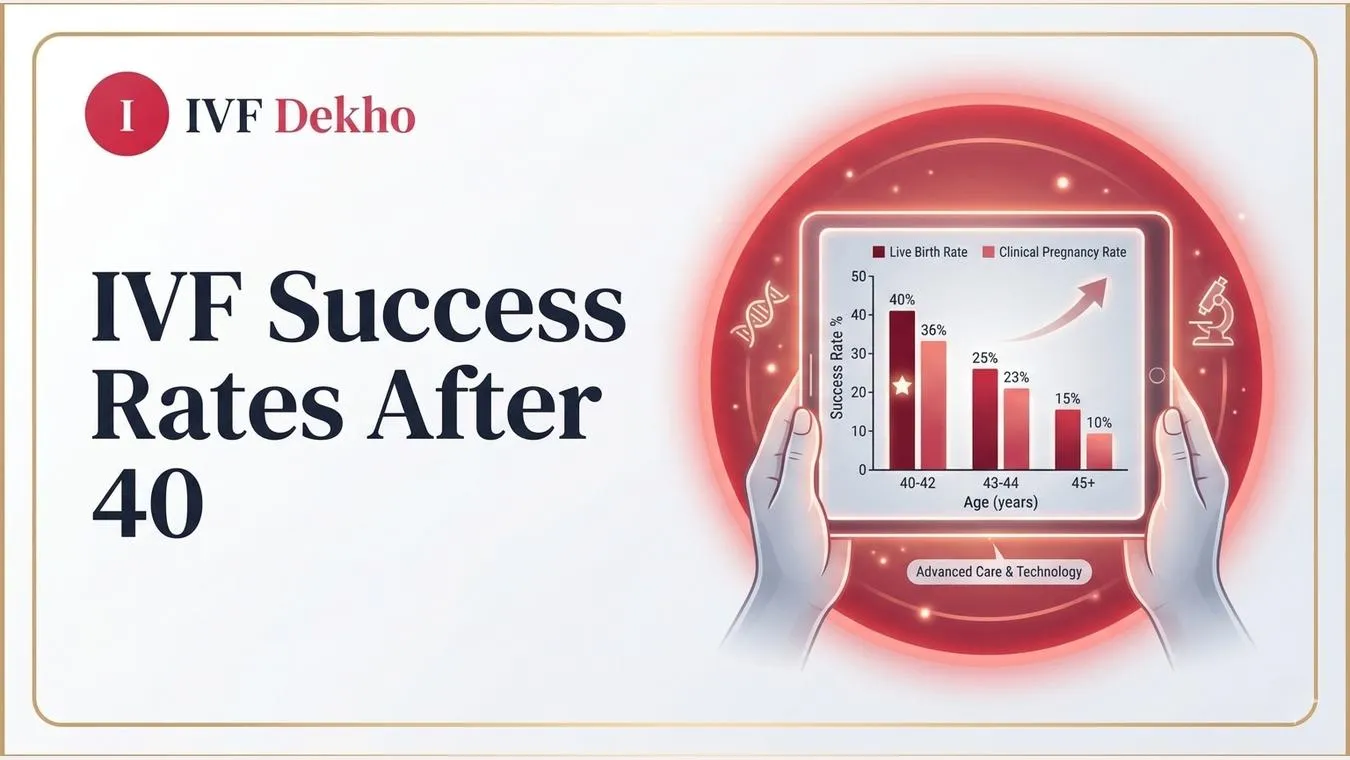
IVF success rates after 40 are one of the most searched and, sadly, one of the most misrepresented topics in all of reproductive medicine. Women in their early to mid forties are increasingly pursuing fertility treatment, often after years of trying naturally, only to find that online information swings between unrealistic optimism and needlessly bleak statistics.
You deserve something better than either extreme. This guide gives you the real numbers, the clinical context behind them, and a clear-eyed view of every path available to you right now.
Why Age 40 Is Such a Significant Threshold in Fertility
Reproductive medicine does not treat age 40 as an arbitrary line. There are concrete biological reasons why fertility specialists pay close attention to this milestone.
From birth, every woman carries her entire lifetime supply of eggs. That number declines continuously and irreversibly throughout life. By the early forties, not only has the quantity of remaining eggs dropped significantly, but the proportion of chromosomally normal eggs has also fallen sharply.
This is the core challenge. It is not that the uterus cannot carry a pregnancy at 42 or 44. In most cases, it absolutely can. The obstacle is finding a chromosomally healthy embryo to transfer.
The Role of Chromosomal Abnormalities
At age 40, approximately 50% to 60% of a woman's eggs carry chromosomal abnormalities. By age 43, that figure climbs to around 70% to 80%. By 45, it can exceed 90%.
- Failed implantation after embryo transfer
- Early miscarriage in the first trimester
- Recurrent pregnancy loss across multiple cycles
- Rare but serious chromosomal conditions in ongoing pregnancies
Understanding this biology is not meant to discourage you. It is meant to explain why certain clinical strategies, particularly embryo genetic testing, have become so central to treatment planning for women over 40.
IVF Success Rates After 40: The Real Numbers
Let us look at the data honestly. IVF success rates after 40 vary significantly depending on whether a woman uses her own eggs or donor eggs, and this distinction matters enormously.
Using Your Own Eggs
| Age | Live Birth Rate per Transfer (Own Eggs) | Approximate Miscarriage Rate |
|---|---|---|
| 40 | 20% to 28% | 30% to 35% |
| 41 | 15% to 22% | 38% to 42% |
| 42 | 10% to 16% | 45% to 50% |
| 43 | 6% to 10% | 52% to 58% |
| 44 | 3% to 6% | 60% to 70% |
| 45 and over | 1% to 3% | Over 70% |
These numbers reflect per-transfer statistics. Cumulative rates across multiple transfers from a single retrieval cycle can be modestly higher.
The Critical Importance of Cumulative Success
A single transfer statistic does not tell the full story. If a 41-year-old retrieves six eggs, achieves three blastocysts, and one passes PGT-A testing, her per-cycle chance may look modest. But across multiple cycles, cumulative success increases.
Using Donor Eggs: A Path Worth Understanding Fully
When IVF success rates after 40 with own eggs become very low, donor egg IVF offers a genuinely different clinical landscape. Because the eggs come from a younger donor, typically aged 21 to 30, the chromosomal quality is dramatically higher.
Donor Egg IVF Success Rates by Recipient Age
| Recipient Age | Live Birth Rate per Transfer (Donor Eggs) |
|---|---|
| 40 to 42 | 50% to 58% |
| 43 to 44 | 48% to 55% |
| 45 to 49 | 44% to 52% |
| 50 and over | 38% to 48% |
The consistency of these figures across age groups is striking. It confirms that the uterus remains a capable environment for implantation and pregnancy well into the mid-forties and beyond. The limiting factor truly is egg chromosomal quality, not the uterus itself.
Choosing donor eggs is not a simple decision. It carries profound emotional, ethical, and identity-related dimensions that every person navigates differently. Many women describe an initial sense of grief around releasing the genetic connection, followed by a gradual and deeply personal process of reframing what parenthood and family mean to them.
Whatever your feelings about this option, they are entirely valid. The decision deserves time, honest self-reflection, and ideally the support of a counsellor experienced in third-party reproduction.
PGT-A Testing: The Single Most Impactful Tool for Women Over 40
Preimplantation Genetic Testing for Aneuploidy, known as PGT-A, screens embryos for chromosomal abnormalities before any transfer is attempted. For women pursuing IVF success rates after 40 with their own eggs, this technology has become close to standard of care at most leading clinics.
What PGT-A Does
- Embryos are grown to the blastocyst stage, typically day 5 or 6
- A small number of cells are biopsied from the outer layer (trophectoderm)
- Those cells are sent to a genetics laboratory for chromosomal analysis
- Only embryos confirmed as euploid (chromosomally normal) are recommended for transfer
What PGT-A Cannot Do
PGT-A improves transfer efficiency by removing chromosomally abnormal embryos from the queue. However, it does not improve egg quality or create more normal embryos. If a woman produces five blastocysts and all five are aneuploid, PGT-A delivers that difficult news but cannot change the biology.
For women over 43, it is common to find that zero or one embryo out of a retrieval batch passes PGT-A testing. This is emotionally devastating information, but it also prevents the physical and emotional cost of transfers that had very little chance of resulting in a healthy live birth.
Strategies That Genuinely Improve Your Odds Over 40
While age-related egg quality decline cannot be reversed, several evidence-supported approaches can help maximize the outcomes available to you.
Prioritise Retrieving More Eggs Through Multiple Cycles
Because the proportion of chromosomally normal eggs is lower after 40, retrieving more eggs gives probability theory a chance to work in your favour. Banking embryos across two or three retrieval cycles before beginning any transfers is a strategy many specialists recommend for women over 41.
Optimise Ovarian Stimulation Protocol
Not all stimulation protocols are equal. Women over 40 often respond differently to standard gonadotropin doses. Your protocol may need to be adjusted based on:
- Your current AMH (Anti-Mullerian Hormone) level
- Your antral follicle count (AFC) from baseline ultrasound
- Your response in any previous cycle
- Whether a mini-IVF or natural cycle approach is more appropriate given your reserve
Lifestyle Optimisation in the Months Before Retrieval
The egg that will be retrieved in three months is already developing its final maturation process now. Lifestyle choices during this window genuinely matter:
- Avoid smoking entirely, as it accelerates ovarian reserve decline
- Limit alcohol consumption
- Maintain a balanced, anti-inflammatory diet rich in antioxidants
- Achieve or maintain a healthy BMI
- Consider supplementation with CoQ10 (ubiquinol form), which has emerging evidence for supporting mitochondrial function in aging eggs
Always discuss any supplementation with your fertility specialist before starting.
Address Underlying Uterine Factors
Over 40, other factors can begin to influence implantation success beyond egg quality alone. Your specialist should evaluate:
- Uterine fibroids or polyps that may obstruct implantation
- Thin or poorly developed uterine lining
- Adenomyosis or endometriosis affecting receptivity
- Potential thrombophilia conditions requiring blood-thinning support
The Emotional Landscape of IVF Over 40
There is a particular kind of emotional weight that comes with pursuing fertility treatment later in life. Many women in this situation describe a sense of urgency that makes each cycle feel higher stakes, and a loneliness born from feeling out of step with their peer group.
Failed cycles over 40 also tend to carry a sharper sting, because the internal narrative so often shifts toward self-blame about timing. That narrative is almost never accurate or fair.
Biological fertility decline is not a consequence of personal choices made in your thirties. It is a feature of human reproductive biology that affects every woman, regardless of how healthy, accomplished, or prepared she is.
Seeking support from a therapist who specialises in fertility-related grief is not a sign of fragility. It is one of the most practical decisions you can make to protect your resilience across what may be a multi-cycle journey.
Having an Honest Conversation with Your Fertility Specialist
The right clinic will not simply present you with a treatment plan. They will sit with you and walk through your individual test results, your realistic range of outcomes with own eggs versus donor eggs, the likely number of cycles required, and the cumulative costs involved.
Questions worth asking your specialist directly:
- Based on my AMH and AFC, what number of eggs do you realistically expect to retrieve?
- What proportion of embryos typically pass PGT-A testing at my age?
- At what point would you recommend considering donor eggs?
- What is your clinic's specific live birth rate for patients in my age group?
- How do you support patients emotionally and clinically through a failed cycle?
A specialist who answers these questions with transparency and compassion, rather than generic optimism, is one you can genuinely trust with your care.
The Bottom Line: Hope That Is Grounded in Reality
Understanding IVF success rates after 40 clearly is not pessimism. It is the foundation of truly informed decision-making.
Women over 40 do achieve successful pregnancies through IVF every single day. The path often requires more cycles, more patience, more emotional reserves, and sometimes a willingness to consider options like donor eggs that were not part of the original plan.
But the path exists. It is real, it is navigable, and for many women who walk it, it leads exactly where they hoped it would. You deserve a team that helps you walk it with full information, genuine support, and unwavering clinical expertise behind every step.